Our team at Northwest ENT and Allergy includes both ENTs and audiologists, so suffice it to say, we’re very passionate about ear and hearing health! The ear is a fascinating and complex organ, and the hearing process is more elaborate than many realize. Believing that knowledge is power, we want to share our expertise and inform our patients about the basics of how the ear works and the hearing process.
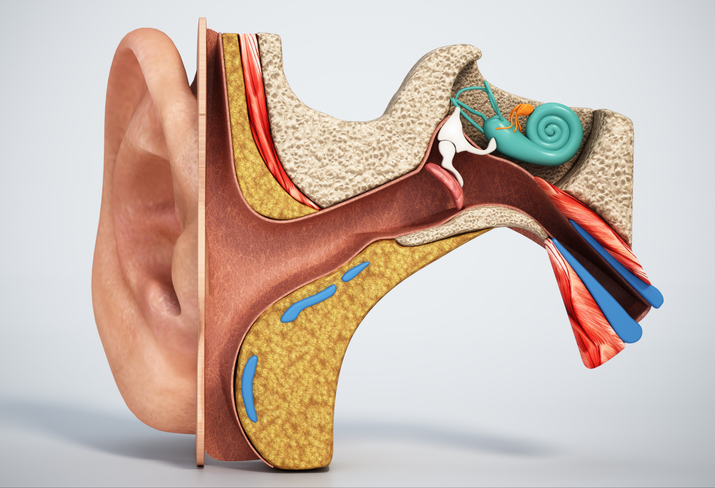
The Journey of a Sound Wave
You probably know that sound travels through the air as waves, but once a sound wave hits your ear, it goes through a multi-step journey in order for you to hear it, and it gets transformed in the process.
Step 1: The Outer Ear
The outer ear is made up of:
- the pinna (the shell-shaped part of your ear that you can see on the side of your head)
- the ear canal
- the tympanic membrane, or eardrum
When you think of the word “ear,” you’re picturing the pinna. The pinna is the entrance to your hearing system. It has all those folds and shapes to catch and funnel sound waves into the ear canal. The waves then travel down the canal and hit the tympanic membrane. This membrane is stretched tightly across the ear canal, much like a drumhead (hence the nickname). When sound waves hit the membrane, it vibrates.
Step 2: The Middle Ear
The middle ear is the chamber directly behind the tympanic membrane. It contains:
- the ossicles bones (the malleus, incus and stapes)
- the Eustachian tube
Fun fact: the ossicles are the smallest bones in your whole body! The three tiny bones form a delicate chain that connects to the tympanic membrane. When the membrane vibrates, the chain conducts that vibration deeper into the ear. Picture those tin-can “phones” connected by string that you made as a kid: the ossicles are like the piece of string that carries your voice from one can to the other.
The Eustachian tube is a small tube that connects the middle ear to the back of the throat. Its function is to drain fluid from the middle ear and equalize pressure between your ears and the outside world. While that means it’s not directly part of the hearing process, hearing problems can occur if the Eustachian tube is affected.
Step 3: The Inner Ear
The inner ear is home to an organ shaped like a snail. This snail has two main parts: the cochlea (the spiral shell) and the semicircular canals (the snail body & antennae). Connected to it is the auditory nerve.
Going back to the tin-can phone metaphor, if the eardrum is one can and the ossicles are the string, the cochlea is the other can, where the sound waves are taken to. The cochlea is the main hearing organ. It is hollow, lined with tiny hair-like sensory cells and filled with fluid. The ossicles conduct their vibrations into the chamber, causing the fluid to ripple. When the fluid ripples, the hair cells ride the waves. The movement of the hair cells generates electrical signals, which contain information about the vibrations. These electrical signals travel up the auditory nerve to the brain, where they are at last processed as sound, and that is when you consciously perceive the sound, or hear.
The semicircular canals are the main balance organ. They, too, are filled with fluid and lined with sensory cells. These behave much like the cochlear cells do—the fluid ripples and the hair cells translate those ripples into electrical signals that the brain can interpret. They react to head movement and gravity.
Our Job
As ENTs and audiologists, we specialize in conditions that affect any part of this complex process. These can range from issues with the structures of the ear (ear infections, otosclerosis) to hearing difficulties (sensorineural hearing loss, conductive hearing loss, tinnitus) to balance issues (vertigo, labyrinthitis). The ear is an incredible organ, and we’re passionate about keeping your ears healthy and functioning properly.
Contact Northwest ENT and Allergy to discuss any ear- or hearing-related symptoms with our specialists. We look forward to helping you!